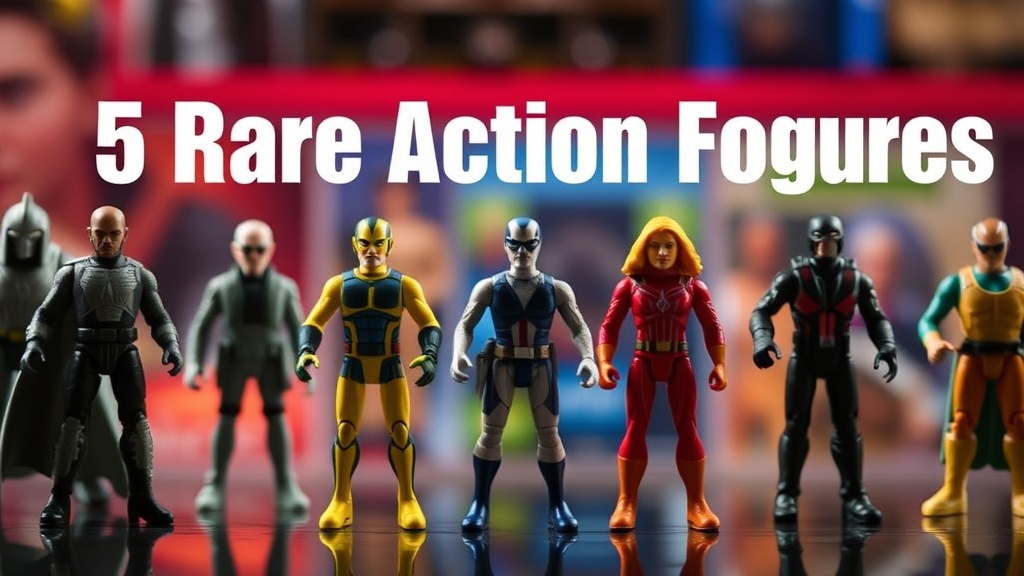
5 Rare Action Figures That Could Fund Your Retirement

1985 G.I. Joe USS Flagg Aircraft Carrier (Prototype)
1978 Star Wars Rocket-Firing Boba Fett (Unproduced)
1986 Transformers Optimus Prime (Factory Error - Chrome Head)
1998 Masters of the Universe He-Man (First Edition with Paint Variation)
2009 Marvel Legends SDCC Exclusive Stan Lee (Signed Limited Run)
What Makes an Action Figure Worth Six Figures?
Certain plastic figures have sold for more than houses. This post breaks down five action figures that have commanded retirement-level prices at auction—and what separates a $10 thrift store find from a six-figure payday. Whether you're digging through childhood storage bins or browsing estate sales in Fredericton, knowing what to look for could mean the difference between a nostalgic keepsake and a life-changing windfall.
Which Star Wars Figure Consistently Tops Auction Records?
The vinyl cape Jawa from Kenner's 1978 Star Wars line holds the crown as the most valuable mass-produced action figure ever released.
Here's the thing—when Kenner first launched the Star Wars line, the Jawa came with a flimsy vinyl cape that looked cheap compared to the cloth capes on other figures. Collectors complained. Kenner switched to a cloth cape mid-production. That vinyl version? They only made it for a few months.
A carded vinyl cape Jawa in decent condition routinely fetches $15,000 to $25,000. Graded examples (AFA 85 or higher) have cracked $50,000 at Heritage Auctions. One pristine example sold for $53,000 in 2023.
The catch? Reproduction capes flood the market. Sellers on eBay list "vinyl cape Jawas" daily—most have reproduction capes worth about $12. Authentic vinyl has a specific texture, thickness, and chemical smell that experts can spot instantly. The cape attaches with two small slits that fray in a particular way over decades.
Worth noting: loose vinyl cape Jawas (no packaging) still command $3,000 to $8,000 if authentic. Check any Jawa you find—the vinyl variant has a small, stiff cape that doesn't drape. If it flows like fabric, it's the common cloth version worth maybe $40.
Why Is the Original G.I. Joe Snake Eyes So Valuable?
The 1982 straight-arm version of Snake Eyes from Hasbro's G.I. Joe: A Real American Hero line represents the perfect storm of rarity, character popularity, and condition sensitivity.
Hasbro produced the first wave of G.I. Joe figures with straight, non-bending arms—cheaper to manufacture, but kids broke them constantly. Hasbro quickly switched to swivel-arm battle grips. The straight-arm Snake Eyes had a tiny production window before the redesign.
That design flaw created scarcity. Kids loved Snake Eyes—the mysterious commando with the mask became the franchise's breakout character. High demand plus low survival rate equals serious money.
A carded straight-arm Snake Eyes (the "twenty-one back" card featuring the original character lineup) sold for $18,000 at auction in 2022. Even loose complete examples fetch $800 to $1,500. The figure came with unique accessories: an Uzi, explosives pack, and silenced pistol. Missing any piece drops value by 60%.
Grading matters enormously here. The white accents on Snake Eyes' chest and shoulders yellow easily. A figure that looks "mint" to casual inspection might grade AFA 60 due to subtle discoloration—cutting value by 75%.
Are Transformers from the 1980s Worth Serious Money?
Absolutely—specifically the original 1984 Optimus Prime in sealed box condition, along with several Japanese-exclusive variants that rarely surface outside collector circles.
The original Optimus Prime (Hasbro #5767) in unopened box condition has sold for $12,000 to $16,000 repeatedly. The value comes from complete, unbroken accessories—the fists, gun, hose, and fuel pump pieces that vanished into carpet fibers by 1986.
That said, the real retirement money lives in Japanese Transformers. Takara released variants and exclusives never sold in North America. The Generation 1 Pre-Transformers Diaclone Battle Convoy—Optimus Prime's predecessor—commands $8,000 to $15,000 depending on sticker condition. The Black Zarak Headmaster from Japan's Super-God Masterforce line has sold for over $20,000.
More accessible but still valuable: the 1984 Megatron (gun mode) sealed in box reaches $4,000 to $6,000. The figure caused controversy—realistic gun玩具 faced restrictions—making sealed examples scarce.
The collector community tracks these sales through TFWiki.net and specialized auction houses. Authentication services like AFA (Action Figure Authority) or CAS (Collector Archive Services) grading add significant premiums—sometimes doubling values for high-grade pieces.
Transformer Investment Comparison
| Figure | Condition | Estimated Value | Rarity Factor |
|---|---|---|---|
| Optimus Prime (1984 US) | Sealed AFA 85 | $12,000–$16,000 | High |
| Megatron (1984 US) | Sealed AFA 80 | $4,000–$6,000 | Moderate |
| Black Zarak (Japan) | Loose complete | $15,000–$25,000 | Extreme |
| Diaclone Battle Convoy | Boxed | $8,000–$15,000 | Very High |
| Soundwave (1984 US) | Sealed AFA 85 | $3,000–$5,000 | Moderate |
What About Teenage Mutant Ninja Turtles Figures?
Playmates' 1988 Teenage Mutant Ninja Turtles line produced one of the rarest mass-market figures in history—Scratch the Cat—and several other variants that sell for thousands.
Scratch started as a standard figure. Playmates planned a wide release. Then something happened—contract disputes, mold issues, nobody knows for certain. The figure barely shipped. Estimates suggest fewer than 500 reached stores, mostly in the UK and Australia.
A loose complete Scratch the Cat (just the figure, no packaging) sells for $800 to $1,200. Carded examples? $8,000 to $15,000 depending on bubble clarity and card flatness. One AFA-graded example hit $28,000 in 2021.
Other valuable TMNT variants include:
- Rocksteady with "Night Ninja" variant paint—miscolored shoulder pads indicate early production, $400 to $800 loose
- 1988 April O'Neil (soft head variant)—early releases had softer rubber heads that warped, $300 to $600 loose
- Mutagen Man with unpainted belly—factory error, $200 to $400
The TMNT collector base runs deep—thirty-somethings with disposable income chasing childhood memories. That emotional connection drives prices higher than pure scarcity would suggest.
Do Any Modern Figures Have Investment Potential?
Modern figures rarely match vintage prices, but certain limited releases and factory errors have already appreciated dramatically.
The 2010 Mattel Masters of the Universe Classics line produced several extremely limited variants. The Queen Marlena and Cringer two-pack—exclusive to the 2013 San Diego Comic-Con—had a production run of perhaps 500 units. Originally $60, sealed examples now sell for $1,200 to $1,800.
Factory errors create instant rarity. A 2015 Black Series Star Wars Rey figure shipped with a lightsaber blade upside-down—Hasbro recalled them, but some reached shelves. That error variant trades for $400 to $600 versus $25 for the standard release.
Funko Pop figures—the vinyl collectibles everyone loves to hate—have produced genuine investment-grade pieces. The metallic version of Hopper from Stranger Things (SDCC 2018 limited to 500 pieces) sold originally for $15. Recent sales: $3,200. The Stan Lee signed gold metallic variant—given to friends and family, never sold retail—commands $4,000 to $8,000.
— Collector sentiment from Fredericton toy show, 2024"The figures appreciating fastest right now aren't the ones sitting on Walmart shelves. They're the convention exclusives with numbered editions under 1,000 pieces—the things collectors ignored five years ago because they seemed too expensive at $40."
What Should You Look For When Hunting?
Condition dominates value. A beat-up vinyl cape Jawa missing its cape might fetch $200. The same figure carded with clear bubble and unpunched hanger tab? Fifty times that price.
Documentation matters enormously. Original receipts, store price stickers, even the plastic bags accessories came in—these details separate $100 figures from $10,000 figures. Keep everything.
The real opportunities hide in estate sales and storage unit auctions—not eBay. eBay prices reflect market awareness. That 1982 cardboard box in your uncle's attic doesn't know what Snake Eyes sells for. Check the arms—straight means money. Check the capes—vinyl means retirement.
Authentication protects everyone. Third-party grading costs $50 to $150 per figure but eliminates doubt. Serious buyers won't touch high-value pieces without AFA, CAS, or UKG certification. The investment pays for itself.
One final note: collect what you love first. The market shifts. Today's $15,000 Jawa might stabilize at $8,000—or climb to $50,000. Nobody knows. But a figure that brings genuine joy holds value regardless of price tags. The best collections—the ones that fund actual retirements—were built by collectors who would've kept those toys even if they'd stayed worthless.
Happy hunting out there.